Mobile App Development
A Complete Development Guide to an AI-Powered Mobile App in...
 Prabhnoor Kaur
- September 8, 2026


 Jailendra Rajawat


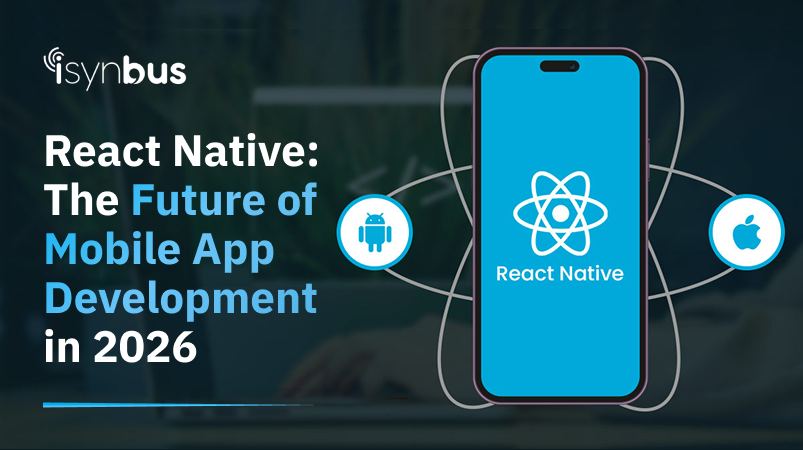
Mobile users expect high-quality apps delivered faster than ever, pushing businesses to adopt frameworks that reduce development time. They require quick apps, which compel organisations to use the latest technologies to shorten development time. In today’s scenario, there is a need to deliver mobile apps across all platforms quickly, and React Native app development is the latest trend in the technology world that enables developers to create efficient apps without compromising on speed or quality. On the other hand, using services from a React Native app development company enables brands to save money and avoid dealing with multiple codebases.
Don’t let development bottlenecks stall your growth. Our React Native experts build high-performance MVPs that scale with your users.
Launch Your MVP →
React Native has come a long way since its inception. Here is how it’s been and where it’s headed in the 2026-2027 landscape:
The bridge architecture was introduced then JavaScript execution and native execution on two different threads. It was revolutionary at that time; however, the async limitation between threads was already part of the foundation.
JSI, Fabric, and TurboModules were introduced. The company started the long-term process of rewriting the whole architecture. Hermes was announced but optional for now. Shopify proved skeptics wrong with production usage.
The tipping point comes: JSI, Fabric, and TurboModules are enabled by default. Bridge-based architecture becomes legacy. The performance gap in cross-platform applications compared to native counterparts almost closes.
A strict end date for using the old bridge comes. Hermes V1 version released as stable. React 19.2 integration stabilized. Windows & macOS development experience improved greatly.
On-device AI inference via Hermes + CoreML/TensorFlow Lite integrations. React Native positioned for super app architecture — multiple services from one codebase. 63% of mobile developers now integrate AI features.
React Native is an open-source platform that provides the facility for developers to develop mobile apps by using JavaScript and new interface designs, along with providing near-native performance. So, a good React Native app development company enables companies to develop iOS and Android apps with a single codebase, saving time and effort on maintenance over the years.
This efficiency has made it the first choice for entrepreneurs and large companies who want to launch quickly and expand without hesitation. The same holds for many other brands that depend on specialised React Native development services to ensure their apps meet high standards and receive timely updates. The reasons React Native is still relevant:
The first benefit of React Native in 2026 is that it enables developers to build apps for both Android and iOS with a single codebase. The process becomes extremely efficient due to reduced development time and easier maintenance. An experienced team can reuse more than half of its code, ensuring consistency and efficiency.
Using React Native enables faster development cycles through reusable components, hot reloading, and libraries. This helps a business launch its MVP, gather user feedback and implement iterative changes more quickly.
React Native greatly reduces development and maintenance costs compared to developing two distinct native applications. It eliminates the need to hire multiple development teams and frees up the budget for innovation and marketing.
Not sure if React Native is right for your complex project? Get a detailed technical roadmap from our senior engineering team.
Book Free Consultation
With features like real-time notifications, secure payments, and responsiveness, your application will surely stand out. Integration with third-party tools becomes quite easy with the assistance of a reputable mobile application company.
Businesses benefit from ready-to-use plugins that streamline their application development. React Native remains a future-ready solution that empowers companies to scale confidently while maintaining reliability.
Perfect for start-ups that need to rapidly validate their ideas with minimal financial investment. It makes it easier for healthcare providers and wellness brands to deliver reliable mobile experiences across both major platforms.
Firms developing dashboards or workflow applications would find it useful to develop cross-platform apps with React Native. These apps require consistent performance and seamless updates.
When developing applications for transportation booking, food delivery, or healthcare appointments, React Native proves efficient with real-time notifications and updates.
Future-proof your mobile strategy. We help established brands migrate legacy systems to high-performance React Native architectures.
Scale My Business →
Ideal for apps revolving around consuming content, communication, and community interaction. Trusted companies identify scalable travel apps with integrated maps and payment gateways as a highlight.
These require high performance, security, and real-time functionality. Including elements like dashboards, videos, and payments is relatively easy as only a single piece of code is needed.
Sometimes your app needs deep access to device hardware, advanced graphical effects, or other features that work best when built natively:
Define what your application should do and target. Integration of technologies such as Auth0, Firebase Auth, Stripe, and analytics solutions are planned. KPIs can include crash-free sessions, API latency, and feature adoption.
Use Node LTS, Android Studio, Xcode and simulators. Ensure Hermes is enabled alongside ESLint, Prettier, and TypeScript. This eliminates dependency conflicts and “works on my machine” issues.
Begin with design tokens for colour schemes, fonts, spacing and radii. Design atoms (buttons), followed by molecules (form groups). This facilitates future updates without affecting other aspects of the UI.
Apply React Navigation for product flows. Ensure secure token storage using Keychain or Secure Store. Handle token expiration properly and implement an offline mode by queuing requests.
Employ Context for UI state, React Query for server-side caching, and Redux Toolkit or Zustand for global state. This eliminates technical debt and promotes scalability as complexity increases.
Replace ScrollView with FlatList, memoise components, and move animations to Reanimated. Compress asset files and pre-cache images. Analyze JavaScript garbage collection cycles and UI thread blocks.
Incorporate crash reporting with Sentry and Crashlytics. Include automated linting, type checking and building in CI/CD. Establish dashboards to track retention and engagement.
| Stats | Source | Where Used |
|---|---|---|
| 43% of engineers use React Native | KMPShip 2026 analysis | Opening stat strip + Section 1 |
| 18,873 companies in production | Landbase 2026 verified data | Stat strip |
| 40x faster JS-to-native via JSI | Production benchmarks | Stat strip + Architecture section |
| 38% cross-platform market share | Statista / TechAhead | Section 1 comparison |
| 43% faster cold starts (Shopify) | Shopify production migration | Performance bars |
| 39% rendering improvement | Shopify production data | Performance bars |
| $50B cross-platform market, 20% CAGR | Industry research | Section 1 |
| 40% enterprise apps with AI agents by 2026 | Gartner | Section 5 |
| 72.55% Android market share (India) | Global data | Section 7 |
| 63% developers integrating AI | Mobile stats 2026 | Timeline |
1. Shorter Development Cycles: Accelerated cycles through hot reloading, component reuse, and code sharing allow for quicker testing of ideas and more frequent app updates.
2. Decreased Expenses: React Native minimises development costs by sharing codes across platforms. Engineers can resolve coding issues in a single go without separate work for each platform.
3. Large Community and Ecosystem: Access to an extensive ecosystem of third-party tools and libraries means developers don’t have to build all functionality from scratch.
4. Near-Native Performance: Features such as the Hermes engine and improved rendering ensure apps perform well. Ideal for e-commerce, SaaS, and on-demand applications.
5. Easier Collaborations: Web and mobile developers work on similar technology stacks, which improves teamwork. New features can be added without rewriting large portions of the codebase.
The use of React Native has become a key component of modern app development, enabling organisations to get off to a good start and expand. The ability to work across various platforms enables innovation at no additional cost. With the right React Native development services, organisations can confidently turn their ideas into reliable digital products that drive growth and customer engagement.
Isynbus has delivered high-stakes React Native apps for global clients. Benefit from our senior engineering team, fixed-price proposals, and 30 days of complimentary post-launch support.
Explore Our React Native Services →

Get the latest insights, updates, and trends delivered to your inbox.