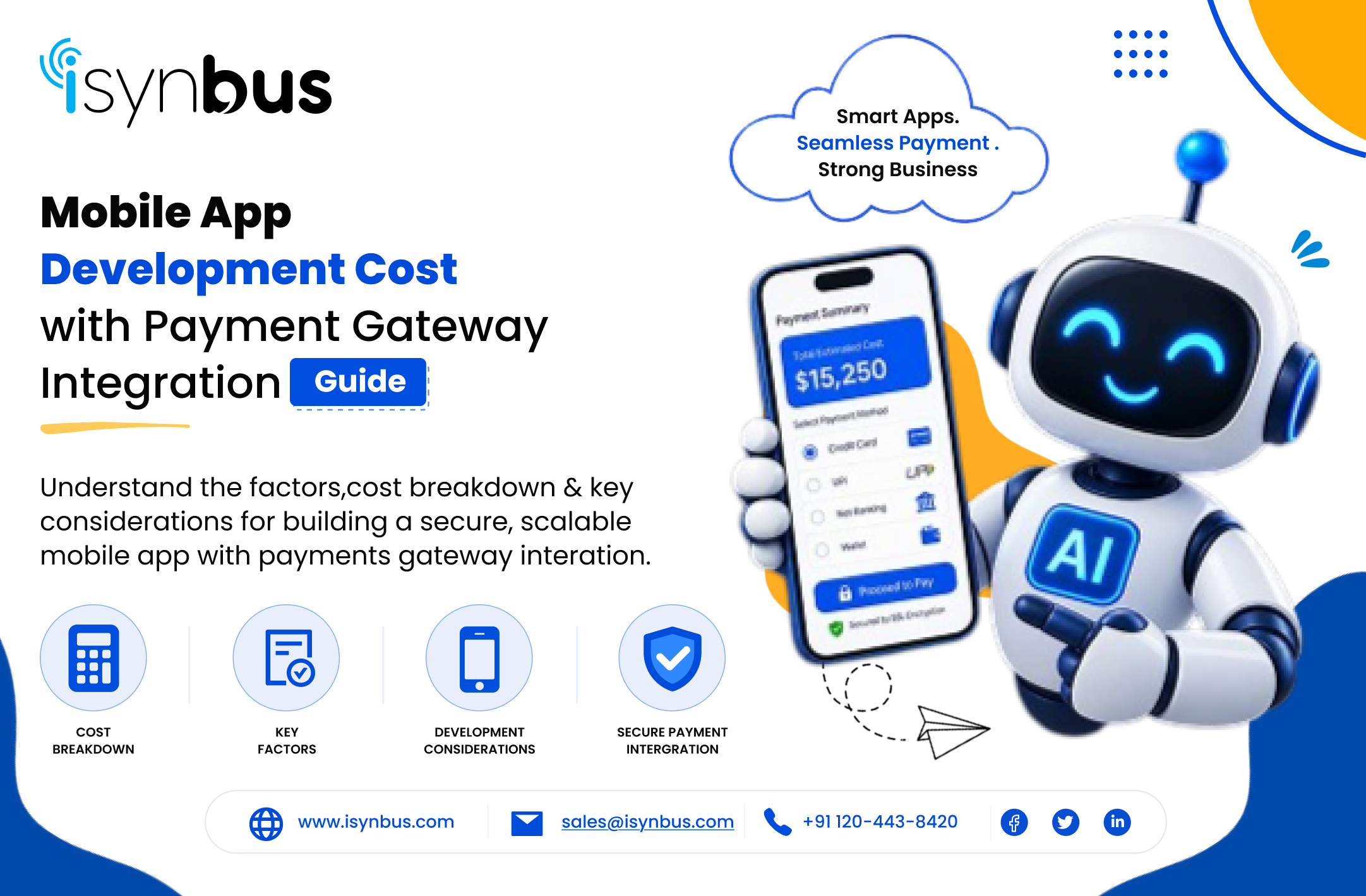
Do you want a mobile app that allows you to make payments easily and securely? Know the mobile app development cost
and payment gateway integration cost before investing. This complete guide on how much it costs to develop an app in 2026 will walk you through development costs, payment integration expenses, the main cost drivers, timelines, security requirements, and hidden charges so you can avoid further surprises and plan intelligently. Even if you are developing an eCommerce app, marketplace, SaaS product, or fintech platform, find out what it takes to launch a trusted mobile app development with payment gateway solutions. Compare your options, dig into the numbers, and build an actual budget that turns your application idea into a revenue-ready product.
How Much Does Mobile App Development With Payment Gateway Cost?
However, no two applications can have the same price tag because a conventional shopping application costs far less than an advanced multi-vendor fintech platform, which has entirely different technical requirements.
| App Type | Approx. Development Cost in India | Typical Timeline |
| Basic app with payment | INR 5–10 lakh | 2–4 months |
| Mid-level business/eCommerce application | INR 10–25 lakh | 4–7 months |
| Advanced marketplace app | INR 20–40 lakh | 6–10 months |
| Fintech / payment-heavy app | INR 30–60 lakh+ | 8–14 months |
| Enterprise-grade payment platform | INR 50 lakh – 1 crore+ | 12–18+ months |
These are indicative development budgets, not payment processing fees.
Current industry guidance indicates that production mobile app costs can range from tens of thousands of dollars to much higher, depending on complexity. App development in India
generally remains more cost-efficient than development in North America and Western Europe. The important difference is this:
It is far less expensive to integrate a third-party payment gateway than to build one from scratch.
Custom payment gateways mean transaction processing, tokenisation, routing, fraud controls, reconciliation, security infrastructure, compliance, and processor integrations. Current estimates for custom gateway development may vary from tens of thousands of dollars for an MVP to hundreds of thousands for production-grade or enterprise platforms.
What Exactly Does Payment Gateway Integration Mean?
A payment gateway is a connection between your mobile application, payment service providers, banks, card networks, and other payment rails that enables hassle-free transactions. When a customer pays through an online application, a fair number of events happen during the process:
- The customer selects a payment method.
- The app creates a payment request.
- The gateway securely processes the request.
- Authentication may be performed.
- The payment provider communicates with the bank or payment network.
- The transaction is approved or rejected.
- The application receives the payment status.
- The order or service status is updated.
- A receipt or confirmation is generated.
- Settlement and reconciliation occur separately.
This is why mobile payment gateway integration is as much a backend engineering task as a UI task. A reliable implementation must also handle failed payments, duplicate requests, refunds, cancellations, payment timeouts, webhooks, transaction status synchronisation, and reconciliation.
How Much Does It Cost to Develop a Secure Fintech Mobile App?
Read More → The Two Numbers You’re Actually Paying For
Every app with commerce built in has two cost centres running in parallel: the app and the payment layer within it. Most budgets fail because they treat budgets as a single line item.
The cost of developing a mobile app – just the app itself, with its login screens, dashboards, content, and notifications – follows a fairly predictable formula based on the number of screens and the complexity of the backend. Add a payment gateway, and now you’re not just building screens anymore. You’re wiring your app into a financial system that has its own rules, its own failure modes, and its own compliance baggage that has nothing to do with how pretty your checkout button is. Here’s about where a regular app would be without the payments:
| Build Type | What’s in It | Cost (USD) | Cost (INR) |
| Lean MVP | Auth, profile, a few screens | $7,000–$18,000 | INR 5.8L–15L |
| Standard business app | Dashboards, APIs, certain real-time data | $18,000–$45,000 | INR 15L–37L |
| Heavier platform | Multi-role, personalised backend logic | $45,000–$130,000+ | INR 37L–1.05cr+ |
Why “Just Add Stripe” Requires More Time
“It’s just a plugin, right? Shouldn’t take long.” I’ve heard this line from more than one client. It actually does take a developer a few hours to connect a payment tool to your app. The expensive part is making that connection safe enough to charge real customers.
A payment setup that works in the real world has to survive things a demo never shows you: a customer who kills your app mid-payment, a bank that times out, a card that gets declined after the item was already reserved, and a refund that needs to partially reverse a split payment. Once real money is involved, none of that is optional, and none of it is taken care of by just switching on a payment option.
This is also the point where a lot of mobile app development with payment gateway work quietly runs over schedule during testing. Teams that budget a week for the payment gateway integration end up spending three, because the cases where a payment fails — not the ones where it goes through smoothly — are where most of the actual work happens.
Breaking Down the Payment Gateway Integration Cost
- A single gateway, off-the-shelf checkout (e.g., Stripe’s or Razorpay’s hosted page) — this is the cheapest path, typically $1,500 to $5,000, as you are essentially configuring rather than building.
- You’re now paying for UI work and secure storage logic on top of the same gateway, and you have a branded, custom checkout screen with saved cards and tokenisation, pushing the range to $5,000–$10,000.
- Two or three gateways that run with fallback logic, so if one provider fails to process a transaction, it automatically retries with another; this is common in India, where UPI outages happen — and that redundancy alone can add $8,000–$18,000.
- Recurring billing subscriptions, auto-renewals, and failed-payment retry emails also fall in a similar $6,000–$15,000 band because the logic around “what happens when a renewal fails” is deceptively complex.
- A custom-built gateway with your own settlement rails and direct bank relationships is a different kind of project, often $25,000 or more, and, honestly, isn’t something most apps need. If you are really considering this route, Isynbus has a pretty good cost analysis of building a payment gateway from scratch. It’s really a fintech-company-kind-of decision, not a standard app decision.
Factors That Affect Mobile App Development Cost
App Complexity
App complexity is one of the biggest cost drivers. A standard application with basic features, which include login, profile management, product listings, checkout, and payment integration, is fairly specific. An application with the following features requires more development time:
- Real-time tracking
- Multiple user roles
- AI features
- Live chat
- Complex dashboards
- Subscription billing
- Multi-vendor functionality
- Advanced analytics
- Multiple payment methods
If an application contains more business rules, more backend development and testing are required.
iOS, Android, or Both?
Building for a single platform reduces the initial budget. But if your target audience uses both Android and iOS, limiting your app to one platform could reduce your market reach. Flutter and React Native frameworks allow developers to share portions of the codebase across multiple platforms, helping to reduce the overall cost of native development.
| Approach | Cost Impact | Best For |
| Native Android | Medium | Android-first products |
| Native iOS | Medium | iOS-centered products |
| Cross-platform | Lower in most cases | Entrepreneurs and broad audiences |
Number of Payment Methods
Payment functionality has gone beyond cards. Depending on the market, you may require:
- Credit and debit cards
- UPI
- Net banking
- Digital wallets
- Bank transfers
- Buy Now, Pay Later
- Recurring payments
- International cards
- Multi-currency payments
Every additional payment channel brings a new API, SDK, authentication requirements, error conditions, and testing scenarios. For an application focused on Indian users, UPI support can be especially crucial due to its widespread adoption among consumers.
Security Requirements
Security features cannot be treated as a luxury or optional, as the payment functionality directly involves users’ financial information, so your application may require:
- Data encryption
- Secure API communication
- Tokenization
- Authentication
- Secure session management
- Fraud detection
- Rate limiting
- Audit logs
- Penetration testing
- Secure storage
- Role-based access control
The compliance burden is also affected by the treatment of payment data. For example, by offloading sensitive card data outside your app environment with provider-hosted or tokenised payment flows, you can reduce the scope of the security environment you need to manage. Security and PCI work can eat up a large portion of your budget when you build a custom payment gateway.
Backend Development
One of the most common budgeting mistakes is to focus solely on the mobile interface. The payment screen looks simple enough, but behind the scenes the backend has to answer some tough questions, which include:
- What if the customer pays and the app is disconnected from the internet?
- What if the payment provider fires the same webhook twice?
- What if the bank confirms payment after the order has already expired?
- But what if you get your money back?
- How do you reconcile the provider’s settlement report with your database?
These scenarios require reliable APIs, transactional state, idempotency controls, background processing, logging, and database architecture. The backend work can have a significant impact on the final cost of mobile app development.
Developer Location
The cost of development may vary depending on the developer’s location. The development teams in North America and Western Europe are significantly more expensive than their counterparts in countries like India and other Asian countries. However, relying solely on cheap rates when choosing a development team can actually backfire if the developer lacks experience with payments, security, or complex integrations. For companies considering mobile app development cost in India, the country offers a strong balance of development capability and cost, especially when working with a team of experienced product engineers. Generally, in India, the mobile application development budget may look like:
| Project Level | Approximate Cost in India |
| Basic app | INR 5–10 lakh |
| Medium-complexity app | INR 10–25 lakh |
| Complex app | INR 25–50 lakh |
| Fintech/enterprise app | INR 40 lakh–1 crore+ |
Design and Checkout Experience
User checkout experience generally depends on payment conversion. A payment screen must not force customers through avoidable steps, and a good checkout flow should provide the following:
- Clear order summary
- Transparent pricing
- Preferred payment methods
- Minimal form fields
- Secure authentication
- Clear loading states
- Helpful payment failure messages
- Retry options
- Instant confirmation
A bad payment UX can cause losses to the business even when the backend payment infrastructure works perfectly. So UI/UX design
should be considered part of your payment investment rather than an unrelated cost.
If You’re Trying to Keep This Affordable
Make your first payment setup easy. Start with one payment option and use the provider’s pre-built checkout instead of building a custom screen from scratch. Pick a gateway that works for your customers, not the one with the fanciest website. We at Isynbus recommend getting an itemized quote that includes payment methods, security, testing, and integration work. Payment gateway costs rarely are the only budget breaker; unclear requirements are. Mobile App Development Cost: Define Payment Scope Upfront to Avoid Surprise Development Work Later. Keep your development cost under control from day one.
Frequently Asked Questions
How to build a mobile app with a payment gateway?
Basic app development costs around ₹5 lakh, and for complex apps, it is over ₹50 lakh. No suggestions
How much does it cost to integrate a payment gateway in India?
The basic third-party integration will cost around ₹50,000–1.5 lakh, depending on features and payment methods you choose.
What’s the best payment gateway for a mobile app?
Select a gateway that suits your customers, payment methods, transaction fees, security, and integration requirements.
How to Cut Down the Cost of Mobile App Development
Start with an MVP, choose a reliable payment gateway, limit payment options at the start, and define integration requirements before development begins.



 Prabhnoor Kaur