Enterprise mobile apps are no longer restricted to internal employee tools. In 2026, mobile applications are
handling field operations, customer engagement, sales, payments, e-commerce, and analytics for businesses.
Choosing the right development platform can directly affect development speed, security, scalability, and
long-term maintenance.
The best platform relies on your business requirements, development expertise, existing technology, and
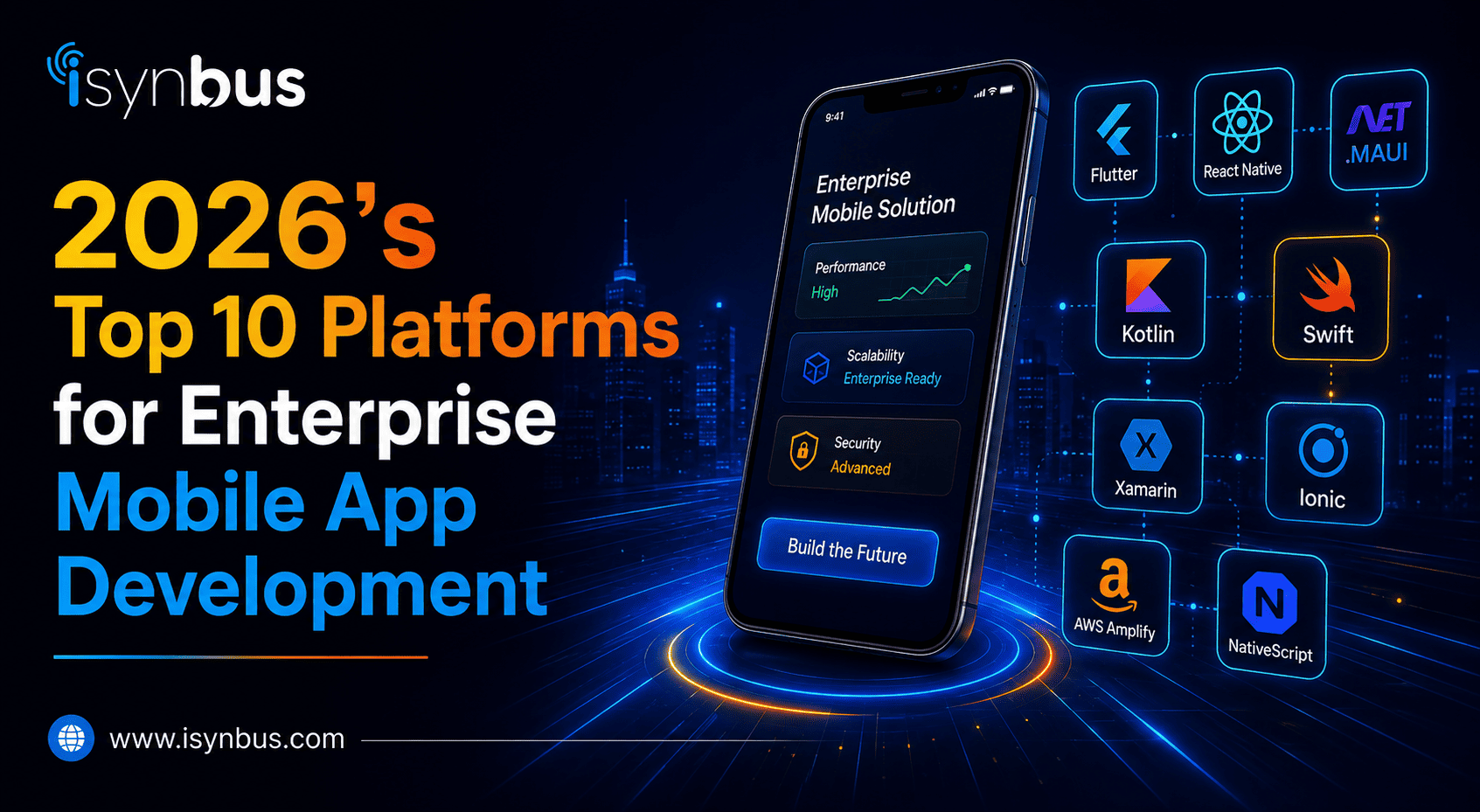
budget. In this blog post, we will discuss the best 10 enterprise
mobile app development
platforms based on
platform capabilities and enterprise adoption.
What is Enterprise Application Development?
Enterprise application development is the process of developing large-scale software applications that can
manage the complex requirements of organizations. These programs often work with multiple different systems,
handle large amounts of data, and help run critical business operations.
When to think about building an enterprise app:
- You need to automate your business processes.
- You need to be able to access real-time data between teams.
- You want to engage customers more through mobile apps.
- Your company handles a lot of data (using data engineering applications).
- You want apps that are safe, that can grow, that are well-made.
Top 10 Enterprise Mobile App Development Platforms
Choosing the most suitable platform for building enterprise mobile apps is critical to creating apps that
scale, are secure, and run smoothly. Below is the list of the top 10 best mobile development platforms that
companies are looking for in 2026:
Mendrix
Mendrix is spearheading the low-code platform for organizations that want to develop business applications as
quickly as possible. Its reusable components, visual development environment, integrations, and AI-powered
features can make it the best fit for enterprises seeking to reduce development time.
Mendrix works smoothly for internal business applications where workflow automation and speed are priorities.
OutSystems
OutSystems is built for enterprises that need sophisticated applications but don’t want to build everything
from the very beginning. Full-stack development, integrations, automation, security, and scalable
deployments are supported. For businesses with complex workflows, OutSystems can be a pragmatic choice for
mobile application development solutions.
Microsoft Power Apps
Power Apps is particularly attractive for enterprises that have already invested in Microsoft 365, Dynamics,
Azure, and other Microsoft technologies. Its low-code approach lets teams build applications while linking
business data throughout the current systems.
Microsoft Power Apps is a strong alternative for internal enterprise apps, inventory tools, approval systems,
and employee-facing solutions.
Salesforce Platform
Salesforce is a natural fit for businesses whose mobile applications are based around
Customer Relationship Management (CRM)
, sales, customer service, or customer data. The Salesforce platform ecosystem can connect
mobile experiences with customer records, analytics, automation, and AI capabilities. Businesses can also
leverage it as a starting point for custom customer-facing applications.
SAP Mobile Services
SAP Mobile Services makes sense for companies already engaged with SAP for ERP and other key operations. Its
ability to link applications with business data, address security requirements, and support office
functionality makes it an asset for large organizations. Logistics, manufacturing, retail, and field-service
enterprises can specifically benefit from this approach.
Flutter
Flutter is a strong option when an organization desires a single codebase for Android and iOS but still wants
a highly customized user experience. It can reduce duplicated development work compared to two completely
different native apps. When companies are working with an experienced mobile app development service,
Flutter can be very useful for customer apps, marketplaces, and ecommerce products.
React Native
React Native is one of the most popular cross-platform mobile app development platforms. Businesses can
develop applications for several platforms while leveraging JavaScript and the broader React ecosystem.
However, it is the best ecosystem for entrepreneurs and businesses seeking smoother, faster product
development without completely sacrificing user experience and native-like performance.
IBM Mobile Foundation
IBM
Mobile Foundation is all about enterprise-grade mobile development, with features for security,
integration, cloud environments, and DevOps. It’s worth considering when complex enterprise infrastructure,
governance, and compliance are primary concerns.
Organizations with stringent security requirements can also embed mobile development in larger
software development and services
initiatives.
Kintone
Kintone is an enterprise solution to automate workflows, collaboration, databases, and processes. Its
user-friendly development environment makes it useful for companies that need custom in-house applications
but do not want to have a large traditional development operation. It can be a practical solution for
departmental applications and workflow-driven business processes.
Zudy Vinyl
Zudy Vinyl is a
no-code application development tool. Visual tools and integrations enable enterprises to
build applications with less traditional coding. This is particularly relevant if business teams need
applications quickly, and the project does not require highly specialized native functionality.
How Much Does Enterprise Mobile App Development Cost in 2026?
Platform licensing is just one element of the total budget. The
How Much Does It Cost to Build an App in India:2026?
can vary greatly depending on
development complexity, integrations, security, compliance, design, testing, and post-launch maintenance. In
India, 2026 estimates for enterprise applications typically range from about ₹5 lakh to ₹60 lakh+, depending
on complexity. US mid-market enterprise projects often range from $75,000 for simpler applications to $1
million+ for highly complex or AI-integrated products. A practical estimate is:
- Basic enterprise app: ₹5–15 lakh
- Mid-complexity app: ₹15–30 lakh
- Advanced enterprise platform: ₹30–60 lakh+
- AI-heavy or highly integrated platform: ₹60 lakh–₹1 crore+
If the project requires both
Android App Development and
iOS App Development as separate native products, costs can increase because teams must maintain
separate codebases. Development effort can be controlled by cross-platform technologies like Flutter and
React Native. Other costs for an
ecommerce mobile app development
project can be related to
payment gateways, inventory synchronization, recommendations, order tracking, promotions, analytics, and
third-party integrations.
How to Choose the Right Platform
There is no one-size-fits-all. Microsoft Power Apps and Mendix are powerful for low-code business
applications, while OutSystems is better for complex enterprise workflows. Salesforce is naturally suited
for CRM-driven applications, while SAP Mobile Services is a natural fit for SAP-centric organizations.
Flutter or React Native can give more flexibility in development flexibility for highly customized customer
products. Companies planning AI-powered products may also benefit from a partnership with an
AI software development company that can integrate machine learning, generative AI, recommendation engines, or
intelligent automation into the mobile experience. The right platform should ultimately support your
business architecture, not dictate it.
📖 Related Reading
Want to learn more about: Why Businesses Worldwide Prefer App Development Companies in India?
Explore the Full Guide →
Frequently Asked Questions
Best enterprise mobile app development platform in 2026?
There is no one best platform. Flutter and React Native are better for custom
cross-platform applications. OutSystems, Mendix, and Power Apps are good for enterprise workflows.
What is the Cost of Developing an Enterprise Mobile App?
In India, enterprise mobile development can start at around Rs. 5 lakh and go up to
Rs. 60 lakh or more for complex applications. AI, compliance, integrations, offline capabilities,
and advanced analytics can add high costs.
Native or cross-platform development — what should a company opt for?
Cross-platform development is generally more cost-effective when support for both
Android and iOS is required. Native development makes more sense when the application requires
highly specialized, platform-specific functionality or maximum native performance.


 Prabhnoor Kaur