Should you choose a ready-made solution or build a custom mobile app?
It is a question that almost every business faces when planning its digital journey. A ready-made app can
help your business launch quickly, while a custom app is created to support your business growth over the
long term. Both ways can be beneficial, but the most suitable choice depends on your budget, future plan,
and business objectives. This comprehensive guide will walk you through both ready-made and custom mobile
apps and help you pick one that best fits your business goals.
What is Custom Mobile App Development?
So, what exactly is custom mobile app development? It is the process of building an
application from the ground up to meet unique business needs. Unlike template-based solutions, these apps
are designed particularly for your workflows, customers, branding, and future growth.
A custom mobile app development company works closely with businesses to assess their goals,
integrate third-party systems, develop custom features, and deliver an application that supports business
objectives over the long term. For companies planning expansion, this personalized approach generally offers
a notable competitive edge.
What is a Ready-Made App?
Ready-made apps, often called “white-label” apps, are pre-developed software programs that you can license or
subscribe to and then customize with your branding. Examples include traditional e-learning platforms or
templated restaurant ordering apps. You are essentially leasing the core functionality that already exists.
This is a quick, budget-friendly way to get started. For as low as $2,000 to $8,000, a small
business can launch on the app stores in two to four weeks, usually with a monthly
subscription. The problem is that you are working within someone else’s architecture, so if your company
requires a feature the platform doesn’t provide, you will either have to live without it or pay for an
expensive workaround.
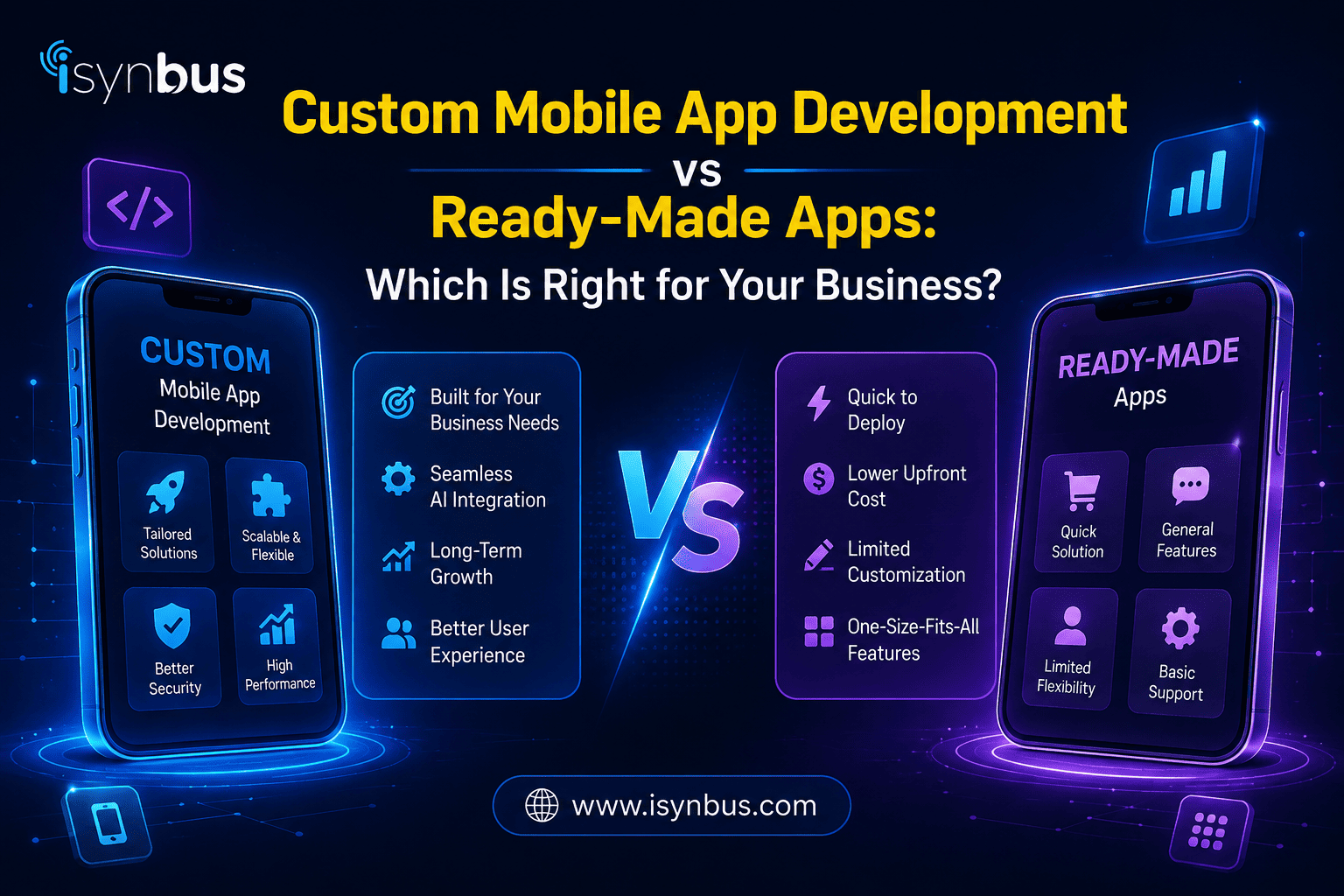
Key Differences: Custom Mobile Apps Vs Ready-Made Apps
| Feature |
Custom Mobile Apps |
Ready-Made Apps |
| Development Approach |
Developed from the beginning to meet unique business objectives |
Pre-built programs tailored for basic business requirements |
| Customization |
Fully configurable design, features, and functionality |
Limited customization options |
| Development Time |
Often takes 3–9 months based on its complexity |
Generally takes a few days to 1 month |
| Upfront Cost |
Higher initial investment |
Lower initial cost |
| Scalability |
Easily grows as your company scales |
May need replacements or upgrades with changing requirements |
| Performance |
Optimized for your company’s processes |
Depends on the vendor’s architecture |
| Security Measures |
Can be planned for your company and compliance needs |
Traditional security features offered by the vendor |
| Third-Party Integrations |
Can combine CRMs
, ERPs, APIs, payment gateways, and other business tools
|
Limited integration capabilities |
| Ownership |
You own the source code and intellectual property |
The vendor owns the platform. You often purchase a subscription or license |
| Updates and Maintenance |
Your technical team or technology partner will manage it |
Managed by software provider |
| Best For |
Business seeking unique features, complete flexibility, and long-term growth |
Entrepreneurs or small businesses requiring a fast, budget-friendly solution |
Which Options Offers Better ROI?
ROI should be measured only by the development cost.
Even a ready-made application may seem affordable at first, but ongoing subscription costs, licensing fees,
limited growth, and feature restrictions can increase expenses over time.
Over three to five years, custom apps typically deliver higher returns for companies seeking
continuous growth. However, custom applications provide a long-term value through:
- Improved customer experiences
- Better operational efficiency
- Stronger security
- Easy collaboration with ongoing business systems
- Complete ownership of the source code and the application.
Where Custom App Development Actually Pays Off
Decision-making can be easier by looking at numbers. With an annual scalability rate of
22.6%, the global marketplace of custom app development is expected to reach
$146.18 billion by 2030 from its estimated value of $43.16 billion in
2024. This continuous growth shows that, because of their long-term value, more businesses are opting for
custom solutions. For example, in ecommerce mobile app development
, a custom app allows you
to design a seamless shopping experience that matches your customers and products. Rather than using a
traditional checkout process, you can design one that makes purchasing smooth, leading to higher conversion
rates and sales.
This also holds true for industries like logistics, where warehouse operations, delivery management, and
inventory tracking can all be made easier with custom apps. Businesses in the healthcare and financial
sectors also favor custom apps because they repeatedly require cutting-edge security features and
industry-specific compliance that off-the-shelf apps may not deliver. Although custom apps cost more
upfront, they often pay off in the long run by increasing productivity, improving customer satisfaction, and
promoting business expansion.
Where Ready-Made Apps Work
A custom-built app is not necessary for every business. A ready-made app lets you test demand for a few
thousand dollars instead of tens of thousands if you’re validating an idea before investing actual funds.
Typically speaking, the more standard your process is, the more sense such apps make; the more unique your
process is, the quicker a template begins to cost more than it saves.
iOS, Android, or Both?
This generally depends on which route you choose. iOS app development
tends to convert
better for premium and subscription products, especially in Western Europe, the UK, and the US.
Android app development suits a price-sensitive market and targets a broader audience in
India and Southeast Asia. Several evolving companies ultimately develop both, natively or with a shared
cross-platform codebase, to control costs.
Which Solution Should You Choose?
If you have a tight budget, need to launch quickly, and your business procedures are very conventional, go
with a ready-made app. If your business needs innovative integrations, long-term growth, enhanced security,
distinctive workflows, or plans to develop AI-driven capabilities, choose custom development. Working with a
dependable, trustworthy partner that offers full software development and services
guarantees that your application will expand with your business rather than eventually become a barrier.
Conclusion
There’s no universally better option, only the one that suits your business goals today. An entrepreneur
testing an idea has different requirements than an established organization hitting the ceiling of a
template. Be honest about your budget, growth timeline, and how different your workflows are, and the right
answer becomes evident.
Frequently Asked Questions
Can a ready-made app be transformed into a custom one later?
Rarely cleanly. Businesses that outgrow platforms usually end up starting over
because most platforms aren’t designed to manage significant structural changes.
Do businesses need separate apps for iOS and Android?
Companies that prioritize performance prefer native apps. However, cross-platform
frameworks allow you to maintain a single app for both platforms, reducing cost and timeline by
roughly half compared to developing two separate native apps.
Is custom app development worth it for small businesses?
It rather depends on complexity than size. A ready-made software solution might work
well for a simple, routine procedure, but custom development often yields a faster return on
investment for a unique process, such as a specialized booking system.







 Prabhnoor Kaur