


Software Development
What Is Claude AI? Complete Guide for Modern Web &...
 Jailendra Rajawat
- May 20, 2026

 Prabhnoor Kaur


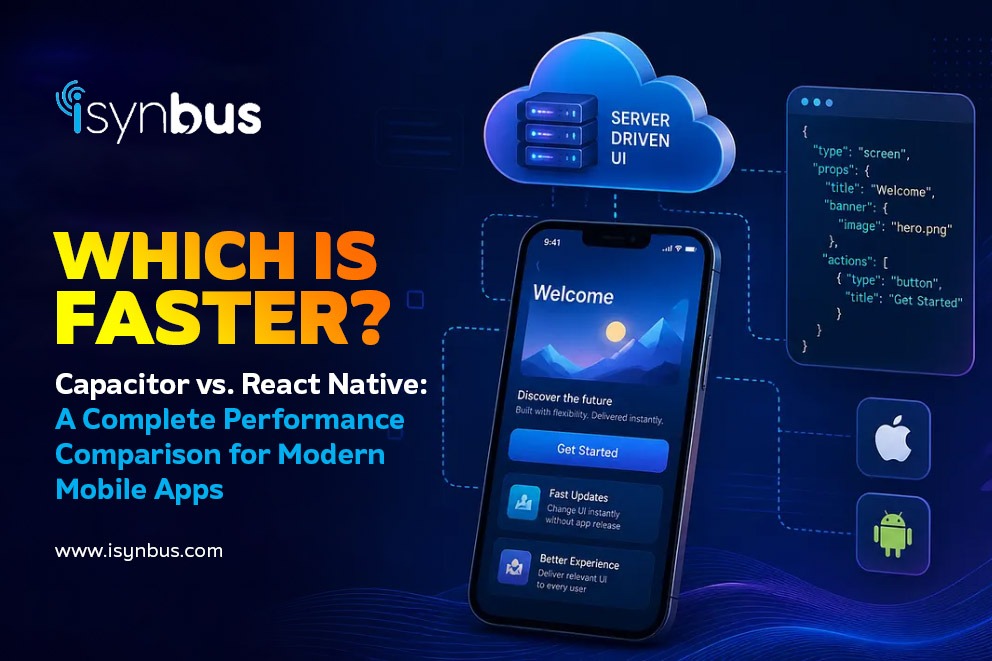
Mobile app performance directly impacts user experience, customer retention, and business growth. Whether you’re building an eCommerce platform, healthcare solution, fintech application, or AI-powered mobile app, choosing the right framework is one of the most important technical decisions.
Among cross-platform technologies, Capacitor and React Native have become two of the most popular options. Both allow developers to build Android and iOS applications using a shared codebase, but they differ significantly in terms of architecture, performance, scalability, and native capabilities.
In this detailed guide, we’ll compare Capacitor vs. React Native from a performance perspective and help you decide which framework best suits your business needs.
Capacitor is an open-source native runtime developed by Ionic. It enables developers to build mobile applications using standard web technologies such as HTML, CSS, and JavaScript while providing access to native device features.
Applications developed with Capacitor run inside a WebView. It acts like a bridge, making it an excellent choice for web teams that want to convert existing web applications into mobile apps with minimal effort.
However, because the UI is rendered inside a WebView, graphics-intensive applications may experience limitations.
React Native, developed by Meta, enables developers to build truly native mobile applications using JavaScript and React.
Unlike Capacitor, React Native renders native UI components instead of displaying web content inside a browser engine. This results in smoother interactions and a more native user experience.
Many leading companies continue to trust React Native for building large-scale mobile applications due to its strong ecosystem and performance capabilities.
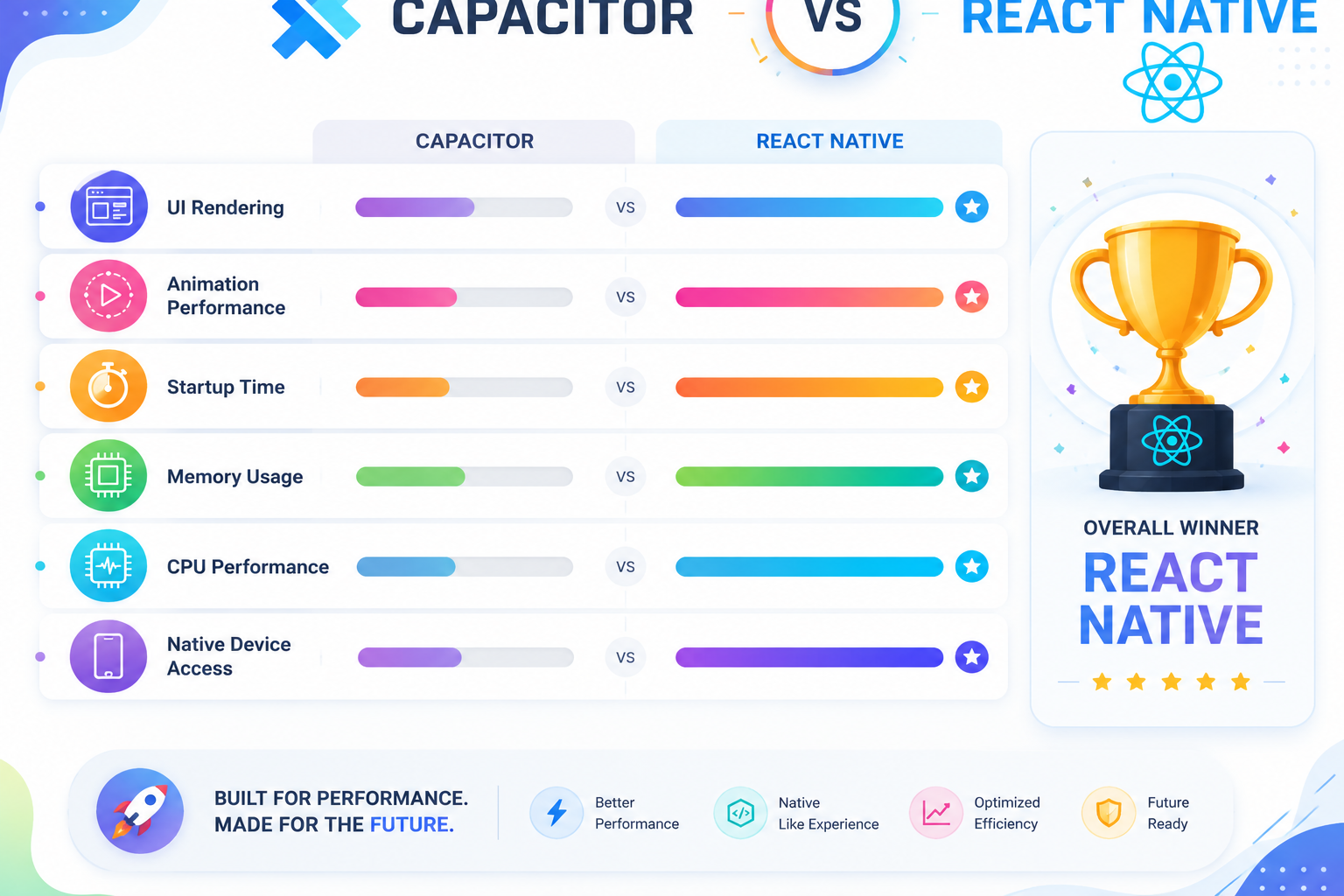
Capacitor relies on the device’s WebView for rendering the interface. Although modern WebViews have become significantly faster, rendering complex interfaces with animations can sometimes introduce delays on lower-end devices.
Best suited for: Business applications, CMS apps, Dashboards, Internal enterprise apps.
React Native renders actual native UI components. This approach offers faster rendering, better scrolling performance, smooth animations, and improved responsiveness.
Winner: React Native
Applications with rich animations require high frame rates. Examples include fitness apps, gaming interfaces, trading applications, and AI visualization dashboards.
React Native integrates smoothly with animation libraries that support 60 FPS experiences. Capacitor relies primarily on CSS animations executed within the WebView. For complex transitions, React Native generally delivers better results.
Winner: React Native
Startup performance affects first impressions. Capacitor loads WebView, HTML, CSS, and JavaScript. React Native initializes a JavaScript engine and native modules.
For lightweight applications, Capacitor may start quickly. For larger enterprise-level applications with large business logic or real-time transactions, React Native often achieves more consistent startup performance after optimization.
Winner: Slight advantage to React Native for large applications.
Memory efficiency becomes critical as applications scale. React Native consumes memory more efficiently because UI rendering occurs natively. Capacitor applications may require additional memory due to the WebView layer.
When handling large datasets, infinite scrolling, multiple API requests, and offline storage, React Native generally performs better.
CPU-intensive operations include image processing, AI inference, real-time calculations, maps, and video streaming. React Native can leverage native modules more effectively. Capacitor performs well but may experience additional overhead when communicating between JavaScript and native code.
Both frameworks support Camera, GPS, Bluetooth, Push Notifications, Biometrics, and File Storage. However, React Native offers a broader ecosystem of mature native modules and community support.
| Performance Factor | Capacitor | React Native | Best Choice |
|---|---|---|---|
| UI Rendering | Uses WebView rendering | Uses Native UI components | React Native |
| App Performance | Good for standard apps | Excellent for complex apps | React Native |
| Animation Smoothness | Good for basic animations | Excellent for advanced animations | React Native |
| Startup Speed | Fast for lightweight apps | Faster for large-scale apps after optimization | React Native |
| Memory Usage | Higher due to WebView layer | More efficient memory management | React Native |
| Native Device Access | Good | Excellent with larger ecosystem | React Native |
| Offline Functionality | Supported | Stronger implementation options | React Native |
| Code Reusability | Very High | High | Capacitor |
| Development Speed | Faster for existing web apps | Moderate | Capacitor |
| Enterprise Scalability | Good | Excellent | React Native |
Performance isn’t the only factor. Development speed also affects project timelines.
Ideal if you already have Angular, Vue, or React web applications. Your existing frontend can often be reused, making development significantly faster.
Requires dedicated mobile development knowledge. However, reusable components, strong tooling, and mature workflows allow experienced teams to build highly scalable applications efficiently. Many businesses choose to Hire React Native developers for long-term projects due to the framework’s flexibility and scalability.
One of React Native’s biggest strengths is its ecosystem. Thousands of React Native libraries are available for authentication, payment gateways, maps, AI integration, charts, video streaming, analytics, social login, and device APIs. This extensive library ecosystem significantly reduces development time.
Artificial Intelligence is transforming mobile experiences. Today’s applications often include AI chatbots, voice assistants, recommendation engines, OCR, image recognition, and predictive analytics.
AI automation solutions integrate seamlessly with React Native using native SDKs and cloud-based AI automation services. Organizations investing in Custom AI Development frequently prefer React Native because of its native performance and extensive integration options.
For businesses targeting both platforms, consistency matters. React Native delivers excellent performance for both Android App Development and iOS App Development. Its native rendering approach ensures platform-specific UI elements feel natural while maintaining a shared codebase.
| Business Requirement | Capacitor | React Native |
|---|---|---|
| Convert Existing Website into Mobile App | ⭐⭐⭐⭐⭐ | ⭐⭐⭐ |
| Enterprise Mobile Application | ⭐⭐⭐ | ⭐⭐⭐⭐⭐ |
| High-Performance App | ⭐⭐⭐ | ⭐⭐⭐⭐⭐ |
| AI-Powered Mobile Solution | ⭐⭐⭐ | ⭐⭐⭐⭐⭐ |
| Real-Time Features | ⭐⭐⭐ | ⭐⭐⭐⭐⭐ |
| Startup MVP Development | ⭐⭐⭐⭐⭐ | ⭐⭐⭐⭐ |
| Complex User Interface | ⭐⭐⭐ | ⭐⭐⭐⭐⭐ |
Capacitor is an excellent option when you already have a web application, your app is primarily content-based, development budget is limited, time-to-market is the highest priority, or native performance is not critical.
Examples include: Educational portals, Corporate dashboards, Internal employee apps, Event applications.
Choose React Native if your application requires native performance, complex UI, advanced animations, offline capabilities, long-term scalability, AI integrations, or enterprise-grade architecture.
Ideal use cases include food delivery apps, fintech platforms, social media apps, healthcare applications, e-commerce apps, and SaaS mobile products.
Many businesses partner with a professional React Native development company to accelerate development while ensuring scalability and maintainability.
The React Native ecosystem continues to evolve rapidly. Recent highlights discussed across the community in react native news april 2026 include improved architecture adoption, better developer tooling, enhanced performance optimizations, more stable native module integrations, and continued improvements to the New Architecture ecosystem. These advancements further strengthen React Native as one of the leading choices for enterprise mobile development.
Selecting the right technology is only part of the equation. Partnering with an experienced mobile app development company ensures your application is built with performance, scalability, and security in mind.
A skilled team offering software development and services can help you define the right architecture, optimize app performance, integrate AI capabilities, build scalable backend systems, and ensure seamless deployment across Android and iOS.
If your project involves React Native App Development, experienced professionals can also leverage modern tooling, testing practices, and reusable components to reduce development time and maintenance costs.
| Service | Benefits for Businesses |
|---|---|
| React Native App Development | Build Android and iOS apps from a single codebase with near-native performance |
| Android App Development | Custom Android applications optimized for performance and scalability |
| iOS App Development | Secure, user-friendly iPhone and iPad applications |
| Hire React Native Developers | Access experienced developers for dedicated or project-based engagement |
| React Native Development Services | End-to-end development, maintenance, migration, and support |
| Custom AI Development | AI-powered applications, chatbots, recommendation systems, and automation |
| AI Automation Solutions | Streamline operations and reduce manual effort through intelligent workflows |
| Software Development and Services | Custom web, mobile, CRM, ERP, SaaS, and enterprise software solutions |
| Vibe Coding Experts | Faster development using AI-assisted engineering and modern development workflows |
The rise of AI-assisted development has introduced new ways to accelerate software delivery. Teams embracing modern workflows, often referred to as Vibe Coding Experts , combine AI-powered coding assistants with engineering best practices to speed up development while maintaining high-quality standards.
This approach is particularly valuable for startups and enterprises looking to launch products faster without compromising on performance or code quality.
| Service Category | Technologies | Ideal For |
|---|---|---|
| Mobile App Development | React Native, Android, iOS, Capacitor | Startups, SMEs, Enterprises |
| Web Development | React, Next.js, Laravel, Node.js | Business Websites & Web Apps |
| AI Automation Solutions | OpenAI, Claude AI , Workflow Automation | Process Automation |
| Custom AI Development | AI chatbots, AI Agents, Recommendation Engines | AI-Driven Businesses |
| ERP & CRM Development | Custom ERP , CRM, SaaS Platforms | Enterprise Management |
| UI/UX Design | Figma, Adobe XD | Enhanced User Experience |
| Cloud & DevOps | AWS, Firebase, Supabase | Scalable Infrastructure |
Both Capacitor and React Native are excellent cross-platform frameworks, but they cater to different project requirements.
If you’re looking for rapid development of web-based applications with minimal native complexity, Capacitor is a practical choice. However, if your priority is high performance, smooth animations, native user experience, long-term scalability, and seamless AI integration, React Native stands out as the stronger option.
Whether you’re planning enterprise-grade React Native App Development, expanding your Android App Development and iOS App Development capabilities, or building AI-driven mobile solutions, investing in experienced react native development services will help ensure your application performs reliably and scales with your business.
By working with a trusted mobile app development company, leveraging proven software development and services, and collaborating with specialists in Custom AI Development and AI automation solutions, you can develop mobile applications that deliver the best user experiences and long-term business value.

Get the latest insights, updates, and trends delivered to your inbox.