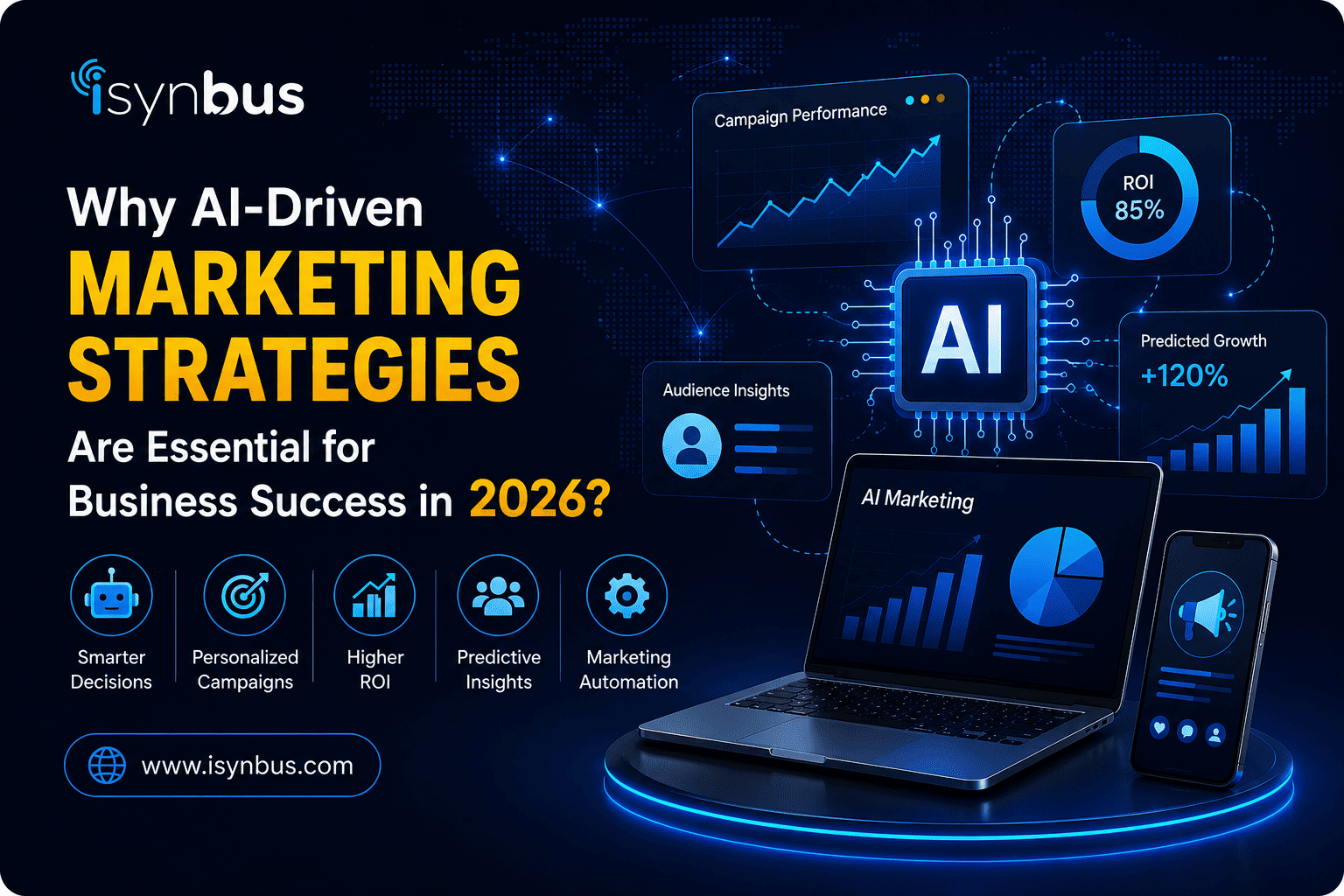
Artificial intelligence is reshaping how businesses connect with customers and compete in digital markets. AI-driven marketing strategies help brands automate processes, deliver personalized experiences and make smarter decisions using all the real-time data. With continuous technological advancement, AI marketing strategies 2026 are anticipated to emerge as an essential catalyst for business growth. From campaign optimization to predictive insights, AI marketing enables organizations to improve efficiency, strengthen customer engagement and achieve better returns on their marketing investments.
What Makes AI-Driven Marketing Vital in 2026?
The biggest difference between generative AI and modern marketing in 2026 is its ability to work with greater autonomy. Today’s AI can analyze customer behavior, optimize campaigns, and handle multiple marketing tasks without human intervention, unlike previous systems that relied on constant human oversight. This shift is helping organizations accelerate AI for business growth through smarter and faster decision-making.
Advanced tools, including AI chatbot marketing
, continuously learn from customer interactions and improve engagement without manual intervention. While many ask, Is AI replacing digital marketers?, the reality is that AI enhances human expertise by handling repetitive work, allowing marketers to focus on strategy, creativity and also on stronger customer relationships.
Traditional Marketing vs AI-Driven Marketing
Marketing is still evolving, and companies are adopting smarter technologies to remain competitive. Intelligent automation, personalized customer experiences, and data-driven decisions are the key factors shaping the Future of AI in digital marketing
. Modern AI analytics tools help businesses understand customer behavior in real time, while AI social media marketing
enables brands to create targeted campaigns, improve engagement, and maximize marketing performance across multiple digital channels.
The comparison below highlights how AI-powered marketing differs from traditional marketing approaches. It explains the key advantages of intelligent automation, real-time insights, and personalisation by helping businesses understand why AI has become an important part of modern marketing success.
| Feature | Traditional Marketing | AI-Driven Marketing |
| Audience Targeting | Broad customer segments | Real-time behavioral segmentation |
| Personalization | Limited | Dynamic, one-to-one personalization |
| Decision Making | Manual analysis | AI-powered predictive insights |
| Campaign Optimization | Periodic updates | Continuous real-time optimization |
| Customer Experience | Generic messaging | Context-aware interactions |
| Budget Allocation | Fixed budgets | AI automatically reallocates spend |
| Reporting | Historical reports | Live performance analytics |
| Scalability | Time-consuming | Easily scales across channels |
Five Foundations of Successful AI Marketing Automation
In order to have an efficient use of AI for marketing automation, a company requires not only a high level of technology but also certain strategies that will help improve targeting and personalization and save money while measuring marketing efficiency.
- Intelligent Audience Segmentation: Modern Generative AI
analyzes customer behavior instead of relying only on demographic data. It segments customers into valuable micro-segments based on their browsing behavior, interests, and engagement and enables businesses to deliver highly relevant campaigns that enhance customer experiences and boost conversion opportunities.
- Predictive Lead Scoring: Marketing teams can use ChatGPT to analyze several engagement signals to assess customer intent. This can help businesses identify prospects that are more likely to convert by enabling them to focus on high-value leads and make the most of marketing resources.
- Dynamic Budget Allocation: Advanced tools like Google Gemini
monitor campaign performance in real time and support budget allocation. Marketing budgets can be optimized for successful campaigns and channels, ensuring that businesses get the most out of their marketing investments.
- Real-Time Personalization: Marketers can use Microsoft Copilot
to generate personalized content and automate customer interactions through various channels. Businesses can enhance customer engagement and minimize repetitive manual work by sending relevant messages at the appropriate time.
- Smarter Attribution Modeling: With Claude AI, companies can gain insights into the entire customer lifecycle, rather than just the conversion. This gives a better understanding of the contribution of each campaign and marketing channel to business outcomes, helping to make better marketing decisions.
Which AI-Powered Agents Will Transform Enterprise Marketing?
AI agents for enterprises are revolutionizing marketing processes through automation and smarter decisions. These AI agents help with activities such as content generation, planning, compliance, and optimization. An understanding of various types of AI agents will enable companies to improve their marketing efforts.
1. Planning Agents
By analyzing historical data, customer preferences and business goals, planning agents assist marketing teams in developing structured campaign briefs. These AI-driven systems can spot opportunities and tailor plans for various channels or regions. By reducing manual coordination and improving strategic alignment, agents allow teams to launch campaigns faster and support the Best AI-driven marketing strategies for small businesses with more data-backed decisions.
2. Librarian Agents
Librarian agents make digital asset management easy by automatically categorizing files, adding metadata, and applying predictive tags. They enable marketing teams to find and repurpose content in a timely manner for campaigns. These agents learn continuously from the usage of assets, and the recommendations evolve. By reducing time spent searching for resources, librarian agents increase productivity and help businesses maintain a more organized and efficient content workflow.
3. Critic Agents
Critic agents enhance the quality of content by checking messaging, tone, sentiment and brand consistency before it goes live. They spot potential problems and make recommendations for improvement during the production process rather than after content is live. These agents also help with AI SEO optimization by analyzing search visibility factors and suggesting content improvements. Moreover, this enables marketing teams to create optimized content that aligns with audience expectations.
4. Compliance Agents
Compliance agents automate content reviews by checking marketing materials against brand guidelines, legal requirements and industry regulations. They can assist businesses in minimizing approval delays by pinpointing compliance issues early in the process. These agents also play a role in AI search optimization
by maintaining the accuracy, trustworthiness, and quality of published content. It enables organizations to stay compliant and more efficient in marketing.
5. Production Agents
Production agents are responsible for repetitive content tasks like translation, localization, image adjustments, and campaign variation creation. They allow marketing teams to create several versions of content for various audiences, regions and channels in a short amount of time. Production agents also assist with AI PPC advertising
by aiding in the development and optimization of ad variations. This automation allows marketers to focus more on creativity and customer engagement.
Therefore, artificial intelligence agents have become necessary for modern marketers because of their ability to automate various processes in content creation and campaigns. Various agents carry out different activities, such as planning, management, and quality assurance, among others. The table below gives an insight into various enterprise artificial intelligence agents and how they make business marketing efficient and effective.
| AI Agent Type | Primary Role | Key Benefits |
| Planning Agents | Analyze data, customer preferences, and business goals to create campaign briefs and strategies. | Faster campaign planning, better alignment, and improved decision-making. |
| Librarian Agents | Organize digital assets, manage metadata, and apply predictive tagging for easier content discovery. | Improved asset management, faster content reuse, and higher team productivity. |
| Critic Agents | Review content quality, tone, sentiment, and brand consistency before publishing. | Better content quality, improved AI SEO optimization, and reduced publishing errors. |
| Compliance Agents | Check content against legal rules, brand guidelines, and industry regulations. | Faster approvals, reduced compliance risks, and support for AI search optimization. |
| Production Agents | Automate content localization, translations, image changes, and campaign variations. | Faster content creation, scalable campaigns, and improved AI PPC advertising performance. |
The Best Practices for Successful AI Adoption
It is important for successful AI adoption not only to incorporate technology into the existing system but also to have well-planned strategies, solid data policies, a competent workforce, and proper processes.
- Build a Strong Data Foundation: The key to successful AI adoption is organized and reliable data. Businesses need to integrate customer data across platforms and establish good data management procedures. AI-driven marketing systems provide insights, enhance personalization, and aid in decision-making within marketing operations all of which rely on a solid foundation.
- Improve Workflows Before Using AI: Before companies adopt technology, they should examine their current marketing processes. Recognizing repetitive tasks and areas where human creativity is needed is crucial for effective use of AI marketing tools
. Therefore, this way, AI can help teams by minimizing manual tasks and freeing up time for strategic work.
- Introduce AI Gradually: It is important for businesses not to adopt all AI solutions simultaneously. By beginning with specific use cases, teams can track outcomes, refine processes and scale up adoption gradually. The gradual adoption of AI automation solutions ensures that organizations can reap the benefits without causing significant disruption to their operations.
- Create Clear AI Governance Rules: There is a need for guidelines that outline the roles of AI, the approval process, and the involvement of humans. Good governance guarantees that AI systems are used responsibly, and that they are of high quality and compliant with regulations during marketing operations.
- Train Teams for AI-Driven Roles: The implementation of AI demands that workers acquire new abilities and adjust to new tasks. By educating teams on how to manage, review and optimize AI-generated content, businesses can leverage the power of AI while maintaining a human touch to enhance their marketing efforts and ensure sustainable success.
How Will AI Transform Enterprise Marketing Strategies in 2026?
The future of AI-driven marketing strategies is all about the synergy between AI and human skills. With the ongoing evolution of technology, businesses can anticipate that more intricate marketing processes will be automated, and teams will be able to concentrate on creativity, planning, and strategic decision-making.
AI marketing strategies in 2026 will likely emphasize connected AI agents, conversational interfaces and privacy-focused customer engagement powered by first-party data. Moreover, AI marketing is not only about replacing marketers but about complementing them to make faster decisions, execute campaigns better and provide more personalized experiences while keeping human oversight for innovation, quality, and long-term business growth.
- AI systems with multiple agents will enable more efficient management of entire marketing campaigns.
- Natural language interfaces will make team communication with AI marketing platforms easier.
- Strategies that focus on privacy will reinforce the use of first-party customer data.
- AI will improve personalization by providing more relevant customer experiences in real-time.
- Human expertise and AI will work together to improve creativity, strategy, and decision-making.
- AI-driven marketing strategies will enable businesses to make smarter, data-informed marketing decisions.
Key Takeaways
To sum up, as competition continues to grow, AI has become a business necessity rather than an optional investment. Businesses that adopt AI-powered marketing strategies will be able to build strong relationships with their customers, operate efficiently and make better decisions based on data analytics. By combining AI marketing automation with effective AI digital marketing practices, businesses can improve campaign performance, adapt to changing customer expectations, and build sustainable growth throughout 2026 and beyond.
FAQs
1. Why are AI-driven marketing strategies important in 2026?
Traditional marketing is based on manual processes and predetermined rules, whereas AI-powered marketing uses data to understand about the customer behavior, forecast trends and adjust campaigns in real-time. It enables businesses to provide more personalized and efficient marketing experiences.
2. How can AI improve marketing performance?
AI can streamline repetitive tasks, process vast customer data, tailor campaigns, optimize marketing budgets, and offer insights that aid in quicker and more informed decision-making. Therefore, it helps businesses improve efficiency, customer engagement and overall marketing results.
3. How do AI-powered marketing agents improve campaign performance?
Marketing teams can work more efficiently and provide better customer experiences with AI-powered agents, which help with planning, content management, quality checks, compliance, and campaign optimization. These agents also help improve productivity, campaign accuracy, and marketing effectiveness.
4. How do AI systems maintain brand consistency?
AI marketing automation streamlines repetitive processes such as audience segmentation, lead scoring, campaign optimization, and reporting. It works in conjunction with AI SEO optimization and AI PPC advertising to ensure that businesses are reaching the right audience.
5. What should businesses consider before implementing AI in marketing?
Smarter personalization, advanced AI analytics tools, intelligent automation, and improved AI social media marketing are all part of the Future of AI in digital marketing. Businesses adopting these innovations will be better prepared to meet changing customer expectations and market demands.



 Prabhnoor Kaur