Every business that sells physical goods fights the same quiet battle. One product sits untouched on a shelf while another sells out by noon. Spreadsheets and fixed reorder rules were built for steadier times, and they struggle once demand, suppliers, and sales channels start shifting every week.
AI-powered inventory management changes that. It reads sales, supplier, and market data together, predicts what customers will buy, and adjusts stock levels before a problem reaches the shelf. This guide explains how the technology works, where it pays off, what it costs, and how to adopt it without disrupting daily operations.
What Is AI-Powered Inventory Management?
AI-Powered inventory management is the use of machine learning to forecast demand, set reorder points, and recommend purchase quantities automatically. Instead of leaning on last quarter’s averages, the system learns from live sales, returns, promotions, supplier delivery times, and even weather patterns, then updates its advice as new data arrives.
Traditional methods run on static rules. A planner sets a minimum and a maximum for each item and revisits those numbers every few weeks. That works while demand stays stable. It breaks when a product trends online or a supplier slips by four days. AI inventory management software closes that gap by recalculating continuously, so decisions stay current without extra manual effort.
Why Traditional Inventory Methods Fall Short
Three problems keep showing up. Forecasts rely on averages that hide spikes and dips. Data sits in separate tools such as the ERP, the warehouse system, and the online store. Planners also burn hours on manual counts instead of supplier talks.
The result is a double loss. Stockouts cost sales and weaken customer trust, while overstock locks up cash and leads to markdowns and write-offs. Both trace back to slow, imperfect information.
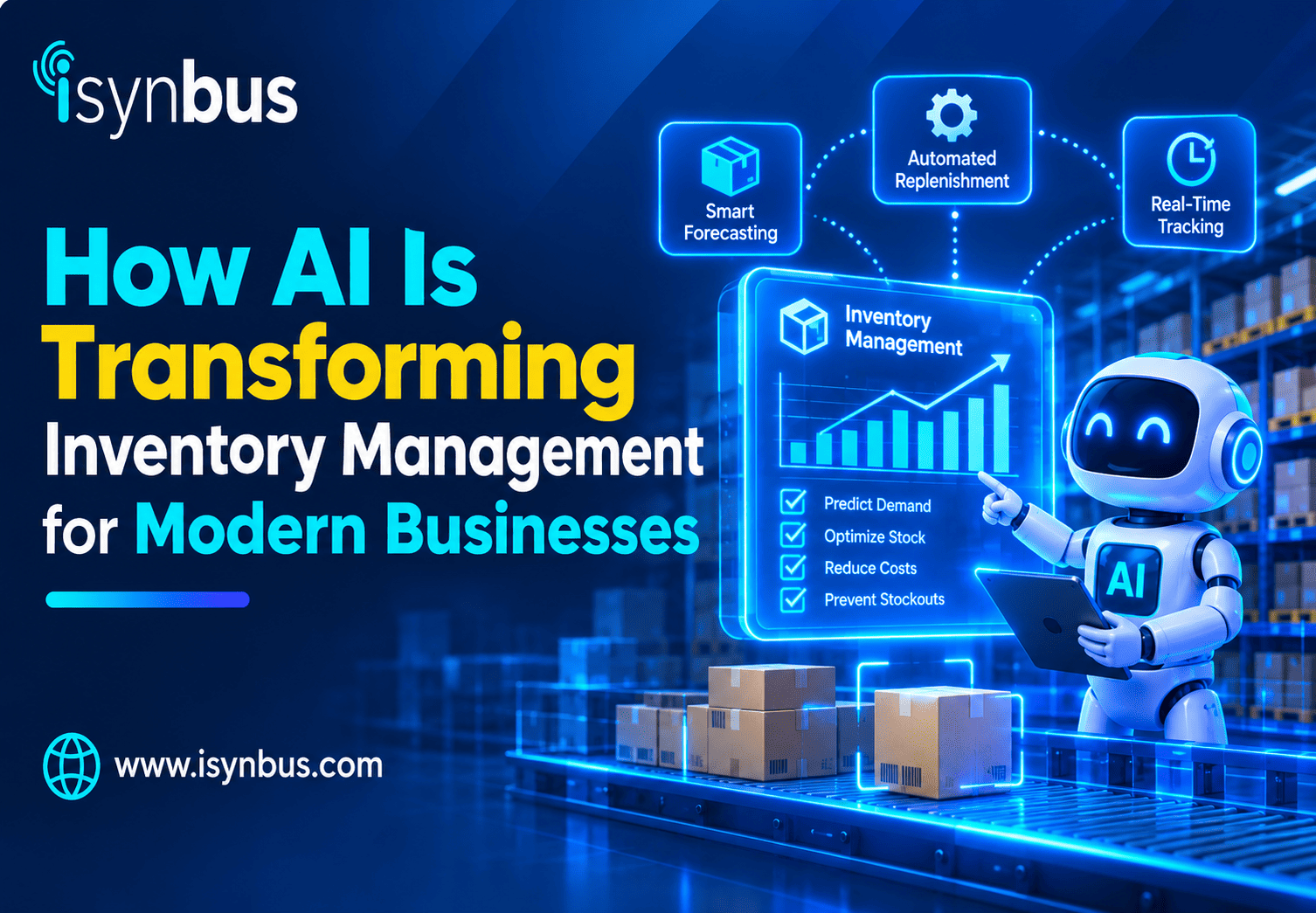
How AI Is Transforming Inventory Management
The shift is not about one feature. It is a set of connected capabilities that replace guesswork with evidence.
Smarter Demand Forecasting
Machine learning models study sales history alongside prices, holidays, promotions, and local events. They forecast demand for each product at each location and express it as a range instead of a single number. A steady item needs a thin safety cushion, while a volatile one needs more. Because the model keeps learning, a few days of unexpected sales lift the forecast automatically.
Dynamic Reorder Points and Safety Stock
Fixed reorder points ignore how suppliers actually behave. AI-powered inventory management tracks real lead times and demand swings, then recalculates the trigger for every item. If a supplier moves from ten days to fourteen, the system raises the reorder point before the shelf runs dry. When a product calms down, it trims the buffer and frees cash.
Real-Time Visibility Across Location
Barcode scans, IoT sensors, and computer vision feed stock counts into one live view. The system can then suggest moving surplus units from a slow store to a busy one, which is often cheaper than placing a new order.
Automated Replenishment
Once planners trust the numbers, approved items can reorder on their own. Staff review only exceptions such as a sudden spike or a new product launch. This is where AI Automation Solutions
show their most visible gains, because routine purchase orders stop waiting in a queue.
Key Benefits at a Glance
The table below compares a rules-based approach with AI-powered inventory management across the areas planners care about most.
| Area | Rule-Based Approach | AI-Powered Inventory Management |
| Forecasting | Moving averages and manual overrides | Models that learn trends, seasons, and promotions |
| Reorder points | Fixed and reviewed monthly | Recalculated from recent demand and lead times |
| Safety stock | One rule for many items | Set per product and location |
| Response to change | Waits for the next review | Updates as orders and delays arrive |
| Planner workload | Grows with the catalog | Stays manageable through automation |
The numbers support the shift. McKinsey has reported that AI can lower inventory levels by 20 to 30 percent in distribution operations and cut logistics costs by 5 to 20 percent. Results vary by business, so record your stockout rate, fill rate, and days of inventory before you start. Without that baseline, you cannot prove the return.
What Data Does AI Inventory Management Software Need?
AI inventory management software needs three things done well. These are clean sales history, accurate stock counts, and real supplier lead times. Weak data in any one of them weakens every forecast.
Steady products need only a few months of history, but seasonal items need at least a full year so the model sees both the peak and the dip. New products have no history, so the system borrows patterns from similar items until real sales arrive.
One trap catches many teams. Sales data shows what you sold, not what customers wanted. If an item sells out at 2 p.m., the zero sales after that look like low demand, and the model underorders next time. The fix is simple. Flag stockout periods so the model treats them as missing demand rather than no demand.
The Role of AI Integration Services
Most businesses already run an ERP, a point-of-sale system, and a warehouse platform. A new model is only useful if it can read from and write to all of them. That is the job of AI Integration Services, which connect the forecasting layer to existing tools through APIs so data flows in both directions.
In practice, the ERP stays the system of record while the AI layer sits on top, pulling clean data and sending order suggestions back for approval. Good integration also covers data cleanup, user permissions, and security, which decide whether planners trust the output. Skipping this step is the most common reason pilots stall.
Buy or Build? Choosing the Right Solution
Ready-made platforms go live in weeks on a monthly subscription. Mid-market planning tools often start near $900 a month, while enterprise suites are usually quoted case by case. The trade-off is that you adapt to the tool, and larger changes depend on the vendor’s roadmap.
A custom build suits unusual workflows, several warehouses or marketplaces, and proprietary data you want to turn into an advantage. As a rough planning range, a focused first version may cost $50,000 to $90,000, and enterprise systems with deep integration run well above that. Data readiness and the number of connected systems move those figures more than anything else.
Where AI-Powered Inventory Management Delivers Most
Retailers use it for store-level forecasts and markdown timing. Manufacturers track raw materials with it, because one missing part can halt a production line. Healthcare providers rely on it to rotate short-dated supplies and protect patient care. Ecommerce brands use it to balance stock across warehouses ahead of seasonal peaks.
Conclusion
AI-powered inventory management pays off once your catalog, channels, or suppliers outgrow spreadsheets and monthly reviews. The value comes from decisions that stay current, such as an order placed two days earlier because a supplier slowed down. Start with a pilot of a few dozen products, run it beside your current method, and let your own numbers decide how far to go. A partner offering AI Automation Solutions and AI Integration Services can map your data, systems, and a realistic first release.
Frequently Asked Questions
How long does it take to see results from AI-powered inventory management?
Most teams see early changes, such as fewer emergency orders and tighter safety stock, within a pilot of two to four months. Larger gains follow as the model collects cleaner data and more products move to automatic reordering.
Can small businesses use AI inventory management software?
Yes, once manual planning becomes a burden. A shop with a few dozen steady items may manage on a spreadsheet, but a business selling across channels or carrying a few hundred products usually benefits from ready-made tools.
Will AI replace inventory planners?
No. It takes over repetitive math and flags exceptions, while planners handle supplier talks, promotions, launches, and judgment calls that data cannot capture.


 Prabhnoor Kaur