Every business owner wants the same thing: more growth with fewer operational headaches.
Yet many businesses still spend hours every day on repetitive tasks that add little strategic value. Sales teams manually follow up with leads. Customer service teams answer the same questions repeatedly. Marketing departments spend countless hours scheduling campaigns and generating reports.
As businesses grow, these manual processes become more difficult to manage. Hiring more staff isn’t always the answer, especially when routine tasks can be handled more efficiently through technology.
Instead of relying on manual workflows, businesses are now using AI to automate lead generation, customer support, appointment scheduling, sales follow-ups, reporting, and internal operations.
The benefits are clear:
24/7Customer engagement
50%Faster operations
70%Less manual work
3xFaster customer response times
In 2026, AI is no longer a competitive advantage for a select few. It is becoming a practical business tool that helps companies save time, reduce costs, and scale more efficiently.
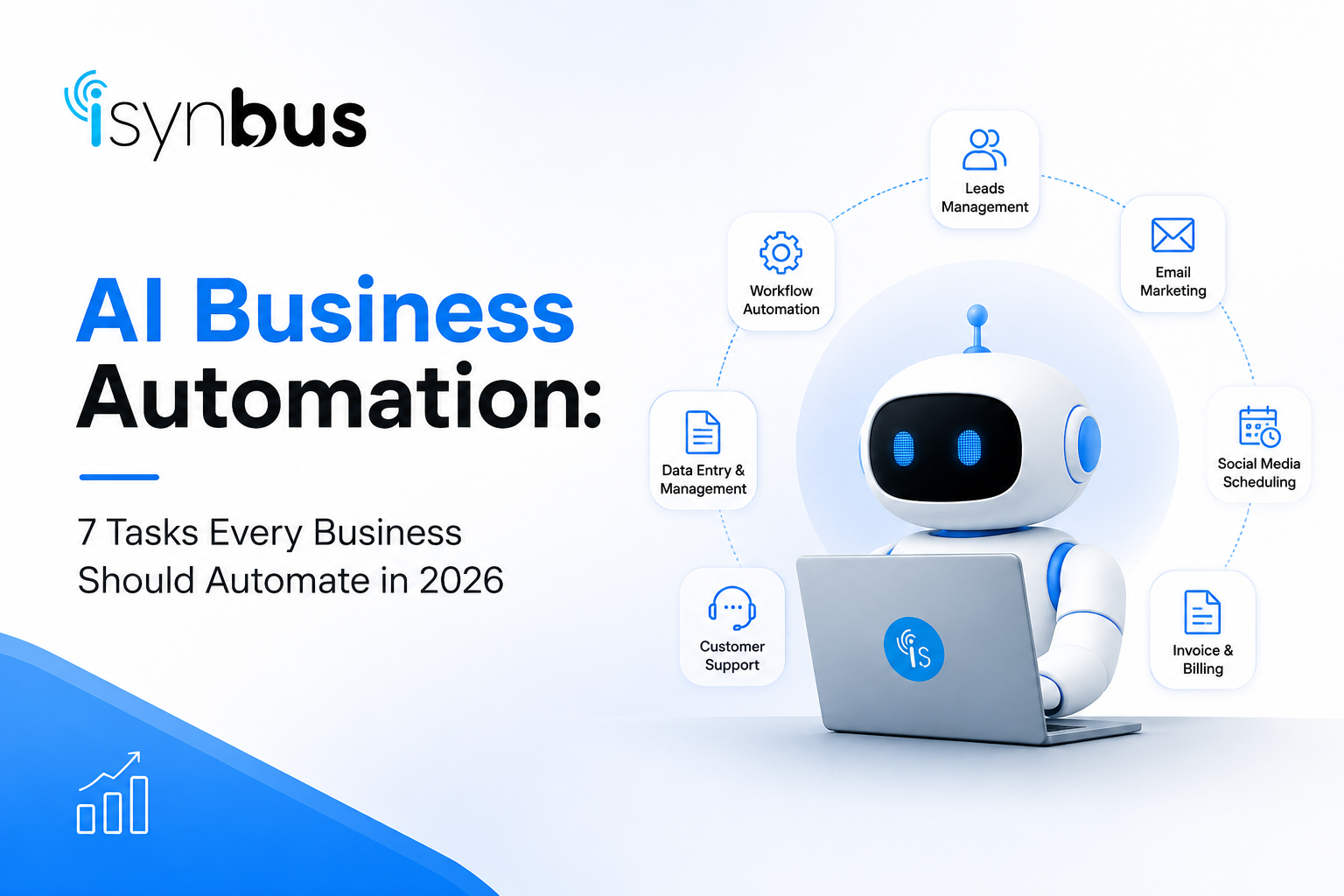
Let’s explore seven business tasks that every organization should consider automating.
1. Lead Generation
Generating qualified leads is one of the most important activities in any business. Unfortunately, many companies still lose potential customers because inquiries are missed or follow-ups happen too late.
With AI Lead Generation, businesses can automatically capture website visitors, qualify prospects, and collect contact information without requiring human intervention.
For example, when someone visits your website looking for information, an AI-powered system can engage them instantly, answer basic questions, and gather important details before they leave.
Instead of waiting for a sales representative to respond the next day, the lead is already captured and ready for follow-up.
Benefits
More qualified leads
Faster response times
Better conversion opportunities
Reduced manual data collection
2. Customer Support
Customers expect quick answers regardless of the time of day.
When support requests pile up, response times increase and customer satisfaction suffers.
Modern
AI Customer Support solutions use intelligent chat agents that can provide immediate assistance around the clock.
These systems can answer frequently asked questions, help customers find information, guide users through processes, and escalate complex issues to human agents when necessary.
Example
A customer wants to know the status of an order at 11 PM. Instead of waiting until the next business day, an AI chat agent provides the information instantly.
Benefits
24/7 support availability
Faster issue resolution
Improved customer experience
Lower support costs
3. Appointment Scheduling
Scheduling appointments may seem simple, but it often consumes a surprising amount of time.
Businesses spend hours managing calendars, confirming availability, and responding to booking requests.
An AI Voice Agent can handle these tasks automatically.
Voice AI systems can answer incoming calls, check calendar availability, schedule appointments, send confirmations, and even handle rescheduling requests.
Example
A healthcare clinic receives appointment requests throughout the day. Instead of relying entirely on front-desk staff, an AI voice agent manages bookings and keeps schedules updated automatically.
Benefits
Fewer missed appointments
Reduced administrative work
Better customer convenience
Improved scheduling accuracy
4. Sales Follow-Ups
Many sales opportunities are lost because follow-ups happen too late or not at all.
Sales teams are often busy managing multiple prospects, making it difficult to maintain consistent communication.
This is where AI Sales Automation delivers significant value.
AI systems can automatically send follow-up emails, track prospect engagement, update CRM records, and notify sales representatives when a lead is ready for direct contact.
Example
A prospect downloads a service brochure from your website. The system automatically sends additional information, schedules future communications, and alerts the sales team when the prospect shows buying intent.
An AI system identifies customers interested in a particular service and automatically sends personalized email campaigns based on their interests and behavior.
Benefits
More relevant marketing
Increased engagement
Better campaign performance
Reduced marketing workload
6. Reporting and Analytics
Business leaders need accurate information to make informed decisions.
Unfortunately, collecting and organizing data manually often delays reporting and limits visibility.
AI-driven reporting tools can automatically gather information from multiple systems and generate real-time dashboards.
Instead of waiting for weekly or monthly reports, decision-makers have access to current performance data whenever they need it.
Benefits
Faster reporting
Improved visibility
Better decision-making
Real-time performance monitoring
7. Internal Workflow Management
Many organizations struggle with disconnected processes, communication gaps, and repetitive administrative tasks.
AI can automate internal workflows by assigning tasks, updating records, managing approvals, and coordinating team activities.
This type of Business Process Automation helps organizations operate more efficiently while reducing errors and delays.
Example
When a new customer signs a contract, the system automatically creates onboarding tasks, updates internal systems, notifies team members, and schedules follow-up activities.
Benefits
Better team collaboration
Faster operations
Improved consistency
Reduced manual work
How AI Workflow Automation Connects Everything Together
The real value of AI comes from connecting multiple business processes into a single automated workflow.
A typical automated customer journey may look like this:
Website Visitor → AI Chat Agent → Lead Qualification → CRM Update → Automated Follow-Up → Appointment Booking → Customer Support
Instead of managing each step separately,
AI Workflow Automation creates a connected system where information moves automatically between tools and teams.
This reduces delays, eliminates duplicate work, and improves the customer experience from the first interaction through long-term support.
What Is the Difference Between AI Automation and Workflow Automation?
Many businesses use the terms
AI Automation and Workflow Automation interchangeably, but they serve different purposes.
Workflow Automation focuses on automating repetitive tasks by following a predefined set of rules. It is designed to execute processes exactly as they have been configured. For example, when a customer fills out a contact form, the system may automatically create a CRM record, send a confirmation email, and notify the sales team. The workflow follows the same sequence every time and does not make decisions beyond the rules that have been programmed into it.
AI Automation, on the other hand, goes beyond rule-based processes by introducing intelligence into business operations. Instead of simply following instructions, AI can analyze data, understand customer intent, recognize patterns, and make recommendations or decisions based on the information it receives. For instance, when a lead submits an inquiry, an AI-powered system can evaluate the lead’s requirements, determine their level of interest, categorize the inquiry, assign it to the most appropriate team member, and even generate a personalized response.
The key difference is that workflow automation focuses on executing tasks automatically, while AI automation focuses on making processes smarter and more adaptive. Workflow automation improves efficiency by reducing manual work, whereas AI automation enhances both efficiency and decision-making by adding intelligence to business processes.
In practice, the most effective business solutions combine both approaches. Workflow automation handles routine and repetitive activities, while AI provides the intelligence needed to improve customer experiences, optimize operations, and support business growth. Together, they help organizations operate more efficiently, respond faster to customer needs, and scale without significantly increasing manual effort.
AI technology continues to evolve rapidly, and businesses that adopt it early are likely to gain operational advantages.
Key trends shaping the future include:
AI Agents
Intelligent systems capable of performing tasks with minimal human involvement.
Voice AI
Advanced voice assistants that can manage customer interactions naturally and efficiently.
Autonomous Workflows
Business processes that operate automatically from start to finish.
Predictive Analytics
Systems that identify opportunities and risks before they occur.
AI-Powered Business Operations
Fully connected environments where sales, marketing, customer service, and operations work together through automation.
Ready to Automate Your Business?
AI Business Automation is helping companies eliminate repetitive work, improve customer experiences, and operate more efficiently than ever before.
Whether you’re looking to automate lead generation, customer support, appointment scheduling, sales follow-ups, or internal operations, the right automation strategy can create measurable business value.
At Isynbus Technologies, we help businesses implement AI Workflow Automation, AI Agent Development, AI Voice Agent solutions, and AI-Powered Business Systems designed to support growth and long-term scalability.
The businesses that thrive in 2026 won’t necessarily have larger teams. They’ll have smarter systems that allow their people to focus on high-value work while AI handles the routine tasks behind the scenes.
Frequently Asked Questions
What is AI Business Automation?
AI Business Automation uses artificial intelligence to automate routine business tasks such as lead generation, customer support, appointment scheduling, sales follow-ups, reporting, and workflow management.
How much does AI automation cost?
Costs vary depending on business requirements, integrations, and the level of automation needed. Simple automation projects may require minimal investment, while enterprise-wide solutions typically involve greater customization.
Can small businesses use AI automation?
Yes. AI automation is increasingly accessible to businesses of all sizes. Small businesses can automate many repetitive tasks without significantly increasing operational expenses.
What is the difference between AI automation and workflow automation?
Workflow automation follows predefined rules to automate repetitive tasks. AI automation adds intelligence by analyzing data, making decisions, understanding customer interactions, and continuously improving outcomes.
Get the latest insights, updates, and trends delivered to your inbox.
Have an idea ?
Let’s Build Something Powerful Together.
1
Our experts will contact you within 24 hours.
2
We analyze your ideas and provide strategic guidance.
3
Enjoy a FREE CONSULTATION with our development team
Fill out the form, and let’s discuss how we can turn your idea into a powerful mobile application.You can also reach us at sales@isynbus.com or call
us
at +91 9891756790
Schedule a Meeting
We deliver innovative digital solutions built for today’s fast-changing world.
4.9
"
I was a little nervous about contracting off shore and giving a
reasonable deposit
as there are so many scams out there. "
Rick Coulthurst
Co-Founder & CEO
4.9
"
They are a company that is known for developing new and innovative services."
Peptide Bioregulator
Co-Founder & CTO
4.9
"
They were highly professional and worked well with us. "
Alliam Italia
Managing Director
Share your requirements at sales@isynbus.com,
and our team will contact you shortly.


 Prabhnoor Kaur