AI & Automation
How AI Automation Helps Startups Save Time and Lower Operating...
 Prabhnoor Kaur
- September 11, 2026

 Prabhnoor Kaur


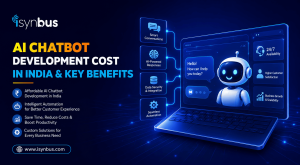
An AI Chatbot Online can do much more than just answer basic customer questions. Today’s conversational systems understand natural language, remember context, retrieve business information, automate routine tasks, qualify leads, assist employees and connect users with the right human agent when needed. For businesses, this translates into speedier responses, lower manual workloads, personalized interactions, and support that’s always on. But what really goes on behind the chat window? From natural language processing and machine learning to APIs, business databases and generative AI, this guide explains how an AI chatbot works, why companies are adopting it and where chatbot technology can create measurable value in sales, customer service, marketing, HR and internal operations.
An online AI chatbot is a software application that interacts with users via a website, messaging platform, mobile application or other digital channel. AI-based systems, unlike conventional rule-based bots that rely heavily on fixed scripts, are capable of understanding natural language, determining user intent, maintaining conversational context, and generating responses. The chatbot platforms of today blend natural language processing, natural language understanding, machine learning, generative AI and large language models together. These technologies enable the system to understand what a person means and not just match a specific keyword.
For example, a customer might enter:
“Yesterday was supposed to be the day my order arrived. Can you see where it is?”
A basic bot might look for the word “order” and send a generic tracking link. An AI-powered system can identify the intent as an order status request, request or retrieve the relevant order information, check connected systems, and provide an appropriate response. This shift from scripted answers to context-aware conversations is one reason businesses are investing in AI Chatbot Development Services.
There is a multi-step technology stack behind a simple chat interface. The exact architecture depends on business requirements, but most modern systems follow a process similar to this:

The process begins when an employee or customer speaks or types into the chatbot interface. The input can be a simple question like “What are your business hours?” or a more complex request like “I want to change my subscription and upgrade my plan.” The system then transforms the input into a format that its AI models can work with.
The chatbot uses Natural language processing to understand human language. Natural language understanding can look at the words, meaning, context and likely intent of a request. The chatbot is able to detect:
| Element | Example |
|---|---|
| Intent | Track an order |
| Entity | Order number |
| Context | Customer has already purchased |
| Sentiment | Frustrated |
| Required action | Retrieve delivery status |
This allows the chatbot to move beyond keyword matching.
An AI-powered chatbot may use prior messages to get the context of the current request. It can also pull information from a company’s approved knowledge base, CRM, help center, product catalog, or internal documentation. For businesses, this layer is particularly important because a chatbot should not rely solely on general model knowledge when answering questions about company-specific products, policies, prices or customer accounts. Enterprise chatbot systems can bridge AI with business data, applications, and workflows to answer questions and execute tasks.
When the system has understood the request and gathered the relevant information, it generates an answer. Depending on the architecture, the response could come from:
This hybrid approach allows companies to have greater control of sensitive or business-critical information.
A smart chatbot can do more than just answer questions. It has the potential to:
This is where custom chatbot development services can be especially valuable. Rather than a generic chatbot, a company can develop workflows based on its own systems and processes.
After responding, the chatbot will be available for the next message. More advanced systems can take into account the context of the conversation to prevent users from having to repeat themselves. If a customer says, “I want to change it to the blue one,” the chatbot can deduce from the previous conversation what “it” is. The key difference between an AI assistant and a simple FAQ tool is this conversational continuity.
An AI Chatbot Online normally combines several technologies rather than relying on one AI model.
| Technology | Role in Chatbot Development |
|---|---|
| NLP | Process human language |
| NLU | Identifies meaning and intent |
| Machine learning | Helps systems recognize patterns |
| Generative AI | Creates natural responses |
| Large language models | Handles complex language and context |
| APIs | Connects the chatbot with external systems |
| Knowledge bases | Provides company-specific information |
| Analytics | Measures conversations and performance |
| Authentication | Protects account-specific interactions |
The architecture becomes even more powerful when these components are connected to CRM, ERP, payment, help desk, scheduling, or other enterprise systems.
Conversational AI is being adopted by enterprises because it can address multiple operational challenges simultaneously.
An AI chatbot can respond after regular business hours. Customers get faster answers, since they don’t have to wait for a support representative to become available. Microsoft highlights the potential advantages of AI-based customer service, such as 24/7 availability, reduced wait times, improved consistency, personalization, scalability and cost-effectiveness.
Customers often want an answer right now. A chatbot can respond to common requests in seconds instead of putting customers in a support queue. This can be particularly useful during product launches, seasonal sales, service interruptions and other periods when the volume of incoming inquiries rises.
Support teams are often asked the same questions about pricing, shipping, returns, account access, product features, and policies. Many of these repetitive interactions can be handled by AI chatbots, freeing up employees to spend more time on complex cases.
Adding more human agents every time customer volume increases can be costly and slow. Artificial intelligence systems can manage multiple conversations at once. Enterprise chatbots are designed to handle high volumes of repetitive customer and employee interactions.
When connected to approved customer data, a chatbot can customize interactions with information such as purchase history, account status, preferences or previous conversations. Personalization can help make automated support more relevant without forcing an employee to manually review each interaction.
The chats offer priceless insight into customer concerns, product questions, objections and preferences. Reviewing these conversations can help organizations identify common problems and areas for improvement across products, documentation, marketing and the customer experience.
The best business case for conversational AI is often in specific workflows, not just adding a chat window on a website.
Standard chatbot software can work well for basic FAQs and simple support. But as companies scale, they often realize they need more integrations and more control. Custom AI chatbot development services can come in handy when a company needs:
A specialized AI chatbot development company can also build the system around the existing business processes, rather than making the organization change its workflow to suit a generic chatbot. For businesses with complex requirements, AI Chatbot Development Services can offer end-to-end services, including architecture, model integration, interface design, system integrations, testing, deployment, monitoring and maintenance. Likewise, chatbot development services can be as simple as a website assistant or as complex as an enterprise conversational platform.
AI Chatbot Online can help businesses improve customer interaction, speed up response time and reduce repetitive workloads. AI chatbots can handle many business functions from customer support and sales to HR and E-commerce . Businesses can develop solutions that integrate with existing systems, provide relevant information, and deliver a better user experience with the right custom AI chatbot development services. The key is to select the right technology and development partner based on specific business goals.

Get the latest insights, updates, and trends delivered to your inbox.